Saturday, April 16, 2011

Sylvia and Sally Here For An Extended Stint

Sylvia and Sally came up at the end of March to weave for two weeks. 
Sylvia threading up her second project

Sally threading her first project

Kate fine-tuning the threading in Sylvia's dishtowel warp

Sally threading her venetian carpet

Sally's fine herringbone clothing fabric

Sylvia working up a draft

Sally's first project finished and hemmed

Sally's venetian carpet on the loom


Sylvia decided she wanted to come up and weave for a couple of weeks, and talked her friend Sally into coming up with her. Sylvia's from Easton, MA and Sally is from Bozrah, CT. They wanted a good stretch of time to weave intensively on a few projects and to work with Kate about understanding pattern drafts a bit better. And of course, on the way they were introduced to Kate's efficient very method of warping and beaming on single-handedly.

Sylvia's first project was an 8/2 cotton warp for dishtowels in a rosepath twill pattern, with what she affectionately called "very ecclesiastical colors". She sampled four different treadlings to show several variations of what could be accomplished with a single threading and tie-up. The effect in each towel was very different, very fine and delicate overall. I'm sorry I don't have a photograph to show you of that project, as it was lovely.

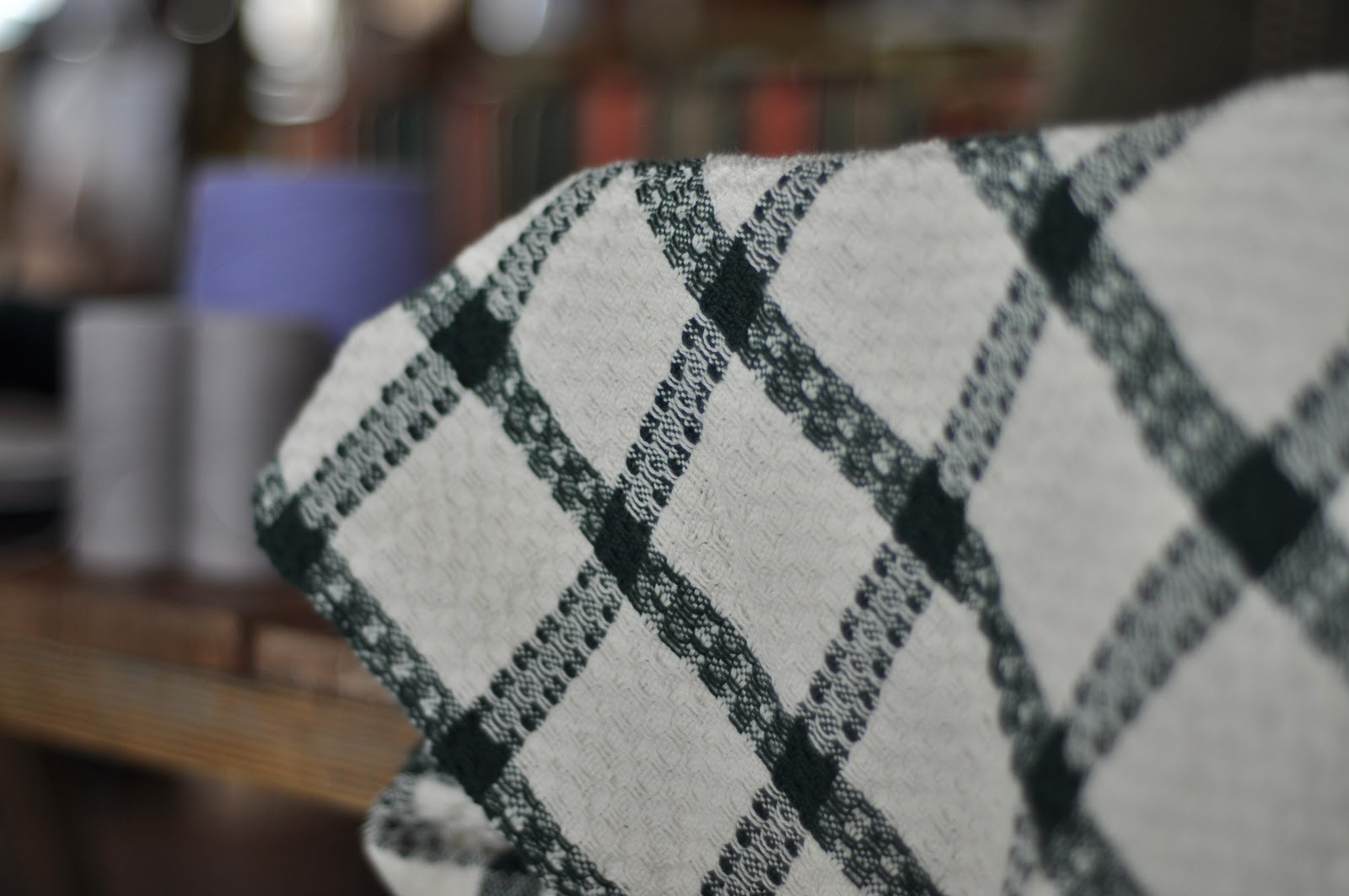
Sally worked on a fine wool baby blanket in a huckaback pattern, with very handsome, classic colors...white and evergreen. Before we knew it she finished up and had hemmed her work.

Sylvia's second project was a fine herringbone in 2's/20 wool, to be used as fabric to make a shirt for her husband. She had an interesting time figuring out the thread color sequence in the warp as well as deciding on the weft color, to try and create the overall effect she was looking for. It was something she had long wanted to make, but hadn't tried before due to the fineness of the warp and weft. But her fabric was beautiful, and she learned more about repairing broken warp threads (which happen to everyone), and really enjoyed creating such lovely and useful cloth of this type.

Sally's second piece was a lush wool venetian carpet, after the Silas Burton patterns. After getting accustomed to putting in every shot with the aid of a sword, she was off and running, and although I wasn't there to see the final product off the loom, I know she finished up quickly because her loom was empty when I returned the following week.

These two weaving friends were a delight to work with and to have with us as a part of our little community for the duration of their stay. We exchanged many stories and shared much information, and we hope they will return to spend more time with us in the future. Sylvia, Sally...thank you!


Friday, April 1, 2011

In Her Own Words...Deborah Livingston-Lowe

My first visit to study with Kate Smith at the Marshfield School of Weaving was in 2006. She was recommended by the most knowledgeable and skilled weaver I know, Rabbit Goody. I attended a workshop by Rabbit on 19th century textiles at Camilla Valley Farms, just north of Orangeville, Ontario. When I expressed an interest in learning more about weaving using 19th century techniques, Rabbit told me about Kate. I was so thrilled to learn about Kate’s work with 19th century barn frame looms and made plans to journey to Vermont from my home in Toronto. I was particularly interested in becoming more knowledgeable about the workings of the barn frame loom.


I learned more about weaving with Kate in those three days than I had learned in my entire experience weaving, which went back to 1983. The foundation that I had in handweaving was slow and inefficient. Kate taught me, in addition to many things, how to use multiple threads when warping, threading, and sleying. All of these techniques, while ideal for the barn frame loom are easily transferrable to a modern loom, which I use at home. Now using Kate’s techniques, I think nothing of setting up a warp because it is so efficient. I felt so welcomed and enriched by Kate and Kate’s teacher, the multi-talented Norman Kennedy. Norman is so generous with his knowledge. I felt like I was getting two courses simultaneously from Kate and Norman. That year, I did a floatwork sampler from "Keep Me Warm One Night" and a rag rug sampler. I learned the proper proportion of warp to binder and pattern, making my work more consistent with 19th century examples.


The next year, I was ready for more. This year my focus was linen weaves, linen singles and warping multiple colour setts such as plaids and checks. We picked a linen pattern from "Keep Me Warm One Night" and I wove a 6’ runner. I also learned how to size singles linen using a historic method. The sizing of linen is essential when using singles, otherwise the linen shreds as you weave. The look and feel of woven singles linen is incomparable and worth the bother. Kate had some beautiful indigo dyed linen which I used with a natural linen. She taught me to warp a plaid pattern using the 15 threads of the repeat in proper sequence. This has been a technique that I have used often since that time. I took that warp home and wove it on my loom.


M's and O's linen


singles linen


In 2008, I wanted to learn the countermarche system. Kate and I set up the treadles and the lamms from start to finish. Kate is a wonderful instructor. She provides just enough guidance while allowing you to have your own hands-on experience. That summer, I also wanted to examine different styles of old drafts. Kate has a wonderful collection that we studied. I settled on an 8-harness twill diaper which I wove on the countermarche loom. Kate has many local students who work on study pieces. They had been investigating double weave when I arrived. There was a little warp left over and I was able to weave a piece for myself.


double weave


twill diaper


The next year, I was interested in reproducing an ikat Venetian carpet and a fine woollen shawl from "Keep Me Warm One Night". The ikat carpet required quite a bit of planning. We had to determine the colours and the width of each stripe. Although the Burnham book is in black and white, the colours are provided in the description. This carpet had several ikat stripes: one set in red and white and the other in green and yellow. Kate has a great dye facility where we dyed the ikat stripes and some of the other colours in the carpet. After dyeing the wool, we set up the complex array of colours and warped. The colours were fabulous and looked amazing on the loom. As I wove the carpet, I felt that I was recreating a bit of 19th century textile history. Ambitious me, I also planned to do an amazing blue and white shawl. I was able to warp it, but didn’t manage to weave it. It is still a project that I have to finish.


ikat carpet on loom


ikat carpet detail


In 2010, I was so enraptured by the wonderful ikat Venetians in "Keep Me Warm", that I planned another project. This time the ikat technique required the ikat to be done after warping. I wound the warp for the borders separately and then the ikat warp for the middle. We wound the warp on and it looked absolutely fabulous. In one week, I dyed, warped and wove 13 yds. Of course, I can’t take all of the credit. Kate’s knowledge and direction really speeded things along. I must also give credit to the kind fairy folk who would slip in after I had left and fill my shuttles, so they were ready to go when I arrived at the break of dawn (Thanks again, Norman. Mòran taing, a Thormoid).


ikat venetian carpet on loom


ikat venetian carpet detail


I have learned so much and have done so many amazing textiles under the expert teaching and care of Kate Smith. I can definitely say, that I wouldn’t be as confident and skilled if I had not had the good fortune to have studied with her. I also have benefitted enormously from Norman, who can hardly utter a word without it being useful and sage.

Friday, March 25, 2011

Has It Really Been Three Months?


Has it really been three months since Mary Margaret began her long-term study? It seems as though the time has flown by faster than any of us could imagine. She was busy during her last three weeks here.

The photos above show her working on a set of 8/2 cotton dishtowels in a turned twill using an 8-harness countermarche set-up. The basic pattern was derived from "Shaker Towels For the 21st Century" by Mary Elva Congleton Erf. It took a whole morning to rig the tie-up, versus an approximate half-hour for a counterbalance tie-up, as each harness is connected to the top and the bottom of the loom. Each treadle carries a piece of the very complex pattern to create different combinations of 4-up and 4-down to form the sheds. Four harnesses make one twill and the other four make the second twill.

Mary Margaret said she loved working on this project because there was so much more pattern potential. It was her first experience weaving with a countermarche set-up. Her towels are beautiful, are they not? Her color choices with this pattern made for a very striking fabric.


Two weeks ago she produced an incredibly handsome venetian carpet. You can see how rich her color and design sense are from the above images. The rep weave carpet was warp-faced with carpet wool, with a chunky cotton filler that Kate dyed a beautiful mottled umber, which set off the selvedge quite nicely without distracting from the brilliant color patterns in the body of the rug.


During her last week with us, she sat curled up in a sheepskin nest under a sunny barn loom and worked on her finishing...darning in all the hundreds of fine color & bobbin change ends on the summer blanket/winter sheet, darning in all the ends on her fine linen towels, & darning ends on her turned twill dishtowels. It gave us all an opportunity to admire her quiet diligence when faced with days-on-end of such tedious but necessary work, and to reflect on our time with her, which has surely been several months of coming to know better a serious, intelligent, funny, sweet, and very dedicated student with a great love for the traditional textile arts.


Here are Kate and Mary Margaret late Thursday afternoon, enjoying some welcome spring sunlight, surrounded by all of MM's beautiful work from the last three months. It has been a delight for all of us to work, and study, and learn with you, Mary Margaret! We will miss your presence very much in the coming weeks, we wish you all of the very best in your continuing adventures.


Tuesday, March 15, 2011

Vermont Weavers Guild Meeting


Kate giving her presentation on the school and her textile business

guild members 

a sampling of textiles made by Kate's textile business

On Saturday the 12th of March, Kate travelled to Randolph, VT to give a talk and slideshow and a workshop at the March meeting of the Vermont Weavers Guild.

The event was well attended by many experienced weavers from around the state, who listened to Kate's morning presentation about the founding and history of the Marshfield School of Weaving, her subsequent apprenticeship to Norman Kennedy, the research she has pursued as an important adjunct to her work as Eaton Hill Textiles, and the recent re-opening of the school.

After a break for lunch, Kate continued the day's activities with a hands-on workshop where she spoke about the use of stripes in traditional textiles, such as calimanco, using many samples of her own work as examples, and then demonstrating the method she uses for building complex striped warps using large spool racks. This multiple spool method using a skarne is what is taught at the school as a standard part of learning to warp.

For more information about the Vermont Weavers Guild and their activities, you can visit their website here.


Thursday, March 10, 2011

Karen Sutherland's February

Karen working on her fabric

the blanket happened last fall during a couple of weeks

her first february project - the rainbow throw

the second one was all un-dyed neutrals except for a pale blue

the third project was a length of wool fabric


Karen Sutherland wound up weaving because she couldn't keep up with her output of handspinning by knitting and crocheting alone, and she had a huge stash she had processed and spun from local flocks that needed to be used.  She had also bought herself a loom, but had no idea what to do with it. Years ago she had dreamt of coming to the school when she lived in Kent's Corner and knew of Norman Kennedy. 


She first came to weave with us last fall and spent a week or so weaving a gorgeous blanket out of a wool-mohair blend she had washed, carded, dyed and spun herself. A lot of it was the same fiber, so it made  sense to weave it into a blanket because she had so much of it. It's quite wonderful, this blanket, very rugged, earthy and seriously warm, with a great heft and texture that commercially spun yarn doesn't really have. 


This first piece was merely an introduction to the process of weaving, so Karen made arrangements to come back and weave for the month of February in order to deepen her understanding of how to plan her own projects, build warps, dress a loom, and experiment with a few different weave structures. She had taken Kate's Local Plant Dye Workshop at Twin Pond Retreat in Brookfield in the summer of 2010 and was excited to use the yarn she had dyed there.
    

For the month of February, she worked diligently on three projects. The first was a rainbow stripe throw, using the natural-dyed yarns from the workshop. It's a bold piece in a herringbone twill with a natural camel-colored criah alpaca weft. The next was another throw, using a lot of un-dyed white and neutral colored yarns with a lovely pale blue as a color accent. We spent quite a bit of time working out the stripe pattern in the warp and all the direction changes on the color changes, so that she could have some further experience in designing her own work. The last project was a fine wool fabric she wove to make what she calls a "Common Thread Garment".  The fabric is subtle but beautiful, with a Gothic cross woven into the pattern. The yarn was a blend of long hair sheep's wool from Romania and lambswool from Sue Johnson in Hinesburg, VT, 
a hand-blended fiber that symbolizes for Karen the cultural exchange she has been working on with artists and musicians in a small village in Romania. 


Over the past five years, Karen has traveled three times to Romania, the first year with a group of folk musicians showcasing Vermont culture in nursing homes, schools and children's homes, and including on-stage theatre pieces involving spinning. Returning the following year with a group of high school students, she and other Vermont artists and musicians created a cross-cultural folk school. With each visit, Karen has brought back wool to combine with Vermont fibers and with the help of experienced weavers created a woven piece from the blend as a symbol of the exchange. Karen plans to use her newfound skills to weave a companion piece of "Common Thread" fabric at home and she says she has enough wool/mohair yarn remaining for at least another blanket.
    
Karen is a performer and teacher of voice and handwork. Her young student, 8 year-old Alya MacManaway is learning weaving, spinning, felting, sewing and singing Scottish songs and will be performing at this year's Young Traditions Showcase on May 14. Karen plans a field trip for Alya to the Marshfield School of Weaving sometime this spring.
    

For more information about Karen and her husband Pete's musical activities you can check out their website here


Sunday, March 6, 2011

Fancy Bedcover Sample

herself at the loom

checking the hand-dyed yarn to finish the checked blanket

Kate offering some hands-on instruction

the red version on the loom

the brown version

brilliant red


Mary Margaret has been working on her fancy bedcover segment of training for the last week. She seemed to be having a great time threading this intricacy, and has become rather adept at threading fairly complex patterns and double-checking as she goes, the end result being accuracy and fewer mistakes needing correction later on. 

Her warp was a traditional fine cotton, wefts were worsted wool, one section a brilliant fire engine red, the other an elegant espresso brown. She wove a fairly small piece, as fabric to cover pillows with, to be used as a first experience with overshot, just to get an overall feel for the issues with threading and setup, and creating and maintaining the even beat so essential for being able to successfully tackle much larger projects, such as a pieced coverlet. 

She breezed through this project in a week, and is now contemplating her upcoming work for the month of March. She'll most likely be putting in several days working with Kate on finishing techniques, as she winds up the final tasks for her summer blanket/winter sheet, linen towelling, checked blanket, and pillowcovers.


Thursday, February 24, 2011

Hot Off the Press

Watch your mailbox for the first volume of our newsletter. In it you'll find this year's schedule of upcoming classes, workshops, and events, along with photographs, an introduction to our staff, and mention of what's been going on at the school. We plan to publish biannually, a summer and a winter edition. 


There have also been some recent updates to our course listings on the school website. We now offer several long-term study weaving intensives, which are described in more detail there.


If you'd like to be on our mailing list and aren't, send your contact information to us at :  kate[at]marshfieldschoolofweaving[dot]com.